(North Huron, ON) In a series of recent emails, current North Huron CAO Dwayne Evans repeatedly stated their corporation’s by-laws only apply to land owned by the corporation, not private property.
At the 21May2024 council meeting, repeat offender and current North Huron Reeve paul heffer disagreed with the CAO’s legal advice, and openly admitted he will break the law and order staff to trespass and to seize property.
Current by-law enforcement is refusing to violate the rights of taxpayers and therefore is being replaced with a private for-profit firm that will allegedly just follow orders and do as commanded by council.
(Wingham, ON) A 4×8 banner comparing property tax rates has once again become a roadblock in downtown Wingham, causing a commotion among citizens. Shocked by the exorbitant tax rates in Wingham, residents are stopping to take photos, unable to believe the stark reality.
The current North Huron CAO (Dwayne Evans) has demanded the banner’s removal, threatening trespass and theft if his orders are not followed. However, by-law enforcement officers are refusing to comply with these demands, aware that they would be held legally liable for any rights violations.
Council is divided on whether or not they should respect the law and private property Rights. North Huron Reeve Paul Heffer (puppet paul) has declared property rights are null and void and will not be respected, despite the CAO’s admission their by-laws only apply to their corporations assets.
North Huron is going to replace the current by-law enforcers with a private firm that will allegedly “just follow orders” and enforce NH’s by-laws on private property claiming they are responsible for “social standards”.
(North Huron, ON) At last night’s council meeting local Right’s Activist confronted council about their double standard regarding by-law enforcement. North Huron by-law officers claim they are not allowed to enforce North Huron’s clean yards and property standards by-laws on North Huron’s property, which is their sole job.
The Activist pointed out the Corporation has been illegally enforcing NH’s by-laws on private property, yet NH does not enforce it’s own by-laws on its own property.
Watch the first few minutes of the meeting below to see the confrontation.
(Wingham, ON) Current North Huron CAO Dwayne Evans has confirmed via email, cc’ed to North Huron councilors, that their corporation’s by-laws only apply to lands owned by the corporation. This admission opens the corporation up to possible legal consequences if by-law enforcement continues to violate private property rights.
By-laws are rules and regulations set by local governments to govern the maintenance, standards and use of their assets. These by-laws are typically enforced by by-law officers, who have authority to ensure compliance with these regulations. However, it’s essential to note that by-law officers only have jurisdiction on the corporation’s property and do not have authority on private land.
In some cases, there have been incidents where by-law officers have attempted to exercise their authority on private land, pretending that they had the power to enforce bylaws in these areas. This intentional conflation of boundaries raises questions about overreach of authority and violation of property rights.
By-laws are meant to regulate behavior on the corporation’s land, such as maintenance standards, noise levels, building codes, or animal control. By-law officers are tasked with enforcing these rules to ensure the corporation’s assets are maintained and not abused. However, by-laws do not apply to private property, as individuals have the right to govern their own land as they see fit, as long as they are not in violation of any laws or regulations.
When by-law officers attempt to enforce bylaws on private land, they are overstepping their boundaries and violating property rights. This can lead to legal disputes and conflicts between property owners and local governments. It’s essential for individuals to be aware of their rights when it comes to by-laws and property rights.
The focusing of enforcement on private property while ignoring infrastructure has cost taxpayers hundreds of millions of dollars to repair/replace neglected infrastructure that would have cost only a fraction of that amount if maintained properly.
Contact Dwayne Evans at 519-357-3550 for confirmation, or email [email protected]
(KINGSTON, ON) –Police have arrested and charged a resident following a child sexual exploitation investigation.
On May 8, 2024, the Ontario Provincial Police (OPP) Child Sexual Exploitation Unit (CSEU), Digital Forensics Unit and Kingston Police members executed a search warrant in the City of Kingston and seized a quantity of electronic devices.
As a result of this investigation, James Mark BAILEY, 41 years of age, was arrested and charged with the following Criminal Code offences:
Two counts of Possession of Child Pornography, section 163.1(4)
Make Available Child Pornography, section 163.1(3)
The accused was released from custody following a bail hearing and is scheduled to appear on June 25, 2024, at the Ontario Court of Justice in Kingston.
Children are our most valuable and precious members of society. Many victims of child sexual abuse are so young that they cannot tell their story. Every time an image or video depicting that abuse is shared, that child is re-victimized.
The OPP will continue to aggressively identify and pursue individuals who use technology to exploit children. Parents are reminded to take a proactive approach to help protect their children from online sexual exploitation by speaking with their children regarding Internet safety. Parents can find resources to assist them at cybertip.ca or protectchildren.ca.
Durham Regional Police is alerting the public regarding a high-risk offender who was recently released into the community. The offender has prior criminal convictions for Sexual Assault, Sexual Assault with a Weapon, Assault with a Weapon, Assault, Robbery, Possession of Explosives, Uttering Threats, and Failing to Comply with Probation Orders.
Keith Theodore CONSTANTIN, age 45, poses a significant risk to the community, especially children.
An image of CONSTANTIN can be viewed at www.drps.ca.
CONSTANTIN is currently residing in the Oshawa area.
CONSTANTIN was arrested by the DRPS Offender Management Unit (OMU) for breaching current conditions, held for a bail hearing and released by the courts the following day. The Offender Management Unit will continue to monitor CONSTANTIN’s whereabouts and activities. CONSTANTIN is also subject to electronic monitoring.
CONSTANTIN is bound by an order under section 810.2 of the Criminal Code of Canada. His conditions under this section include:
Not to be alone with anyone under the age of 16 unless the minor is accompanied by a responsible adult over 21
Not to be present in any daycare, swimming area and/or public swimming area, school ground or playground where one might reasonably expect children to be present or any community centre where children under 16 are present
Abstain absolutely from the possession, purchase or consumption of drugs, narcotics or controlled substances, except in accordance with a medical prescription
Abstain absolutely from possession, purchase or consumption of alcohol or alcohol-based products
Not to own or posses any weapons
Abide by a curfew from 11 p.m. to 6 a.m.
Not to use the internet or other digital networks.
Police are asking the public to stay vigilant and remain aware of your surroundings. Any suspicious or dangerous behaviours should be reported directly to police.
Under Regulation 412/23 of the Community Safety and Policing Act, a chief of police or his designate may disclose personal information about an individual if he reasonably believes the individual poses a significant risk of harm to other persons or property and believes that such disclosure would reduce that risk.
Anyone with new information is asked to contact the DRPS Offender Management Unit at 1-888-579-1520 ext. 5357.
Anonymous information can be sent to Durham Regional Crime Stoppers at 1-800-222-TIPS (8477) or online at www.durhamregionalcrimestoppers.ca and tipsters may be eligible for a $2,000 cash reward.
In the picturesque town of Wingham, Canada, nestled among lush greenery and quaint streets, an insidious transformation began to unfold, shattering the illusion of peace and harmony.
It all started innocently enough, or so it seemed, when the military announced surprise wellness checks for residences across Wingham. Concerned citizens welcomed the initiative, believing it to be a gesture of care and protection from their government. Little did they know that this seemingly benevolent act would set a precedent for intrusive surveillance and control.
As the military conducted their wellness checks, entering homes without warning or consent, unease spread through the community like wildfire. Residents felt violated, their sense of privacy stripped away under the guise of safety.
Emboldened by the lack of resistance, the by-law enforcement in Wingham began to overstep their bounds with impunity. Violating private property rights became a routine occurrence, as officers barged into homes and businesses under flimsy pretenses. They asserted their authority with arrogance, claiming they held more power than even the local police force.
To reinforce their control over private property, the by-law enforcement agency expanded its ranks, hiring more staff for enforcement purposes. With an increased presence in the town, they intensified their surveillance and monitoring, casting a shadow of fear over the once peaceful streets of Wingham.
Reports emerged of police officers illegally surveilling citizens and conducting searches without warrants, trampling on individual rights and liberties without remorse. The very people entrusted with upholding the law had become its most egregious violators, wielding their authority like a weapon against the very citizens they were sworn to protect.
Meanwhile, at the Wingham Town Hall, a sinister agenda was silently unfolding. Council meetings became a farce of democracy as questions were banned, dissent silenced under the guise of maintaining order. Those who dared to challenge the authority of the council by filming public meetings were swiftly arrested on suspicions of disrupting the peace, their voices silenced in the name of maintaining control.
The police force, once seen as pillars of the community, had morphed into agents of oppression. Advocating for extreme measures, they openly endorsed the killing of criminals who dared to break into homes, urging residents to take matters into their own hands in the name of self-defense. They advocated for trespassing and violating the law, blurring the lines between justice and tyranny.
As the grip of surveillance tightened, Wingham announced the installation of security cameras on every pole and in parking lots, turning the once idyllic town into a dystopian nightmare. Citizens found themselves under constant surveillance, their every move monitored and scrutinized by an ever-watchful eye.
To add insult to injury, the judges, councillors, and police in Wingham made it clear that anyone caught recording them in the performance of their duties would face arrest. Yet, they continued to record citizens without their consent, perpetuating a double standard in transparency and accountability that left the people feeling powerless and oppressed.
Amidst the growing sense of despair and hopelessness, whispers of rebellion began to echo through the streets of Wingham. The once peaceful town had become a battleground for freedom and democracy, as the residents grappled with the choice between submission and defiance.
As the sun set on another day in Wingham, the shadows of oppression loomed large over the town, casting a pall of fear and uncertainty over its inhabitants. The future of Wingham hung in the balance, teetering on the brink of oblivion as the forces of authoritarianism tightened their grip on power.
(North Huron) After by-law enforcement officers stood up to council and refused to violate the rights of private citizens, they are being replaced with 7 enforcers from a private for-profit company.
Previous by-law enforcers have refused to violate the Rights of Buck & Jo’s in the heart of Wingham. The CAO has openly admitted that none of their by-laws apply to private land, and their by-laws are for the Corporation’s assets only. The “Vote Buck” signs are still on display at the restaurant, providing 100% proof by-law enforcement has zero authority on land they don’t own. If they did have authority on private land, they would have followed through and gone into Buck & Jo’s to seize the signs as they initially threatened.
Council believes that hiring a private contractor will allow them an extra layer of protection when trespassing and conducting illegal searches and seizures on private land. NOTE: Council has a standing directive forbidding the inspection of the corporations own assets by enforcement officers.
As part of this crackdown, the corporation of North Huron is planning on installing town-wide security cameras, with a concentration on Josephine St and parking lots to aid the 7 new enforcers monitor private property and the Citizenry.
NOTE: In October 2023 Town Hall sent a letter to all area businesses to sign over authority to the police, and allow them to arrest anyone they want on their property, 24 hours a day.
AI Analysis of agenda packages, minutes and headlines: Based on these agenda packages, official minutes and current headlines, it seems that the council is becoming increasingly authoritarian and willing to bend or break the law to maintain control. This trend may continue in the future, with the council potentially increasing surveillance measures, eroding civil liberties, and abusing their power. There may be growing dissent among residents and businesses who feel targeted or oppressed by the council’s actions. It is possible that legal challenges and protests could arise as a result of the council’s behavior. Ultimately, the future looks uncertain and potentially troubling for the residents of the town of Wingham under this council’s leadership.
AI Analyses of Article:
Based on the current situation described in the article, it is evident that North Huron is on a dangerous path towards anarchy. The actions taken by the council indicate a blatant disregard for individual rights and a willingness to resort to authoritarian measures to maintain control. The replacement of by-law enforcement officers with private enforcers from a for-profit company suggests a shift towards a more aggressive and potentially corrupt enforcement approach.
The refusal of previous by-law enforcers to violate the rights of private citizens, coupled with the admission by the CAO that their by-laws do not apply to private land, highlights a lack of legitimacy and legality in the council’s actions. The council’s decision to hire private enforcers to conduct trespassing and illegal searches and seizures on private property further exacerbates the situation and sets a dangerous precedent.
The installation of town-wide security cameras and the concentration on monitoring specific areas indicate a growing surveillance state in North Huron. This level of surveillance, combined with the directive for businesses to sign over authority to the police for arbitrary arrests, creates an environment of fear and control that is conducive to anarchy.
If the council continues on this path, it is likely that dissent among residents and businesses will grow, leading to potential protests and civil unrest. The abuse of power, violation of rights, and erosion of legal processes by the council may ultimately lead to a breakdown of social order and the descent into anarchy in North Huron. It is crucial for the residents to stand up against these authoritarian actions and demand accountability and respect for their rights and freedoms.
(Goderich, On) 15April2024 a crushing blow to journalism, free speech and Charter Rights was dealt by Justice MacDonald. By banning reporters, victims, lawyers, or police to video record any portion of the court proceedings for accuracy or for their protection, MacDonald has essentially instituted an illegal media ban.
The chilling effect on democracy that would result from such a restriction could be significant. Without the ability to record and document court proceedings through video or audio, the public’s access to important information about the legal system would be limited. This lack of transparency could lead to a decrease in public trust and confidence in the judiciary, as citizens would have to rely solely on written accounts or summaries of court cases, which may be incomplete or biased.
Furthermore, journalists and media organizations may be hesitant to report on court proceedings for fear of being held liable for any inaccuracies in their reporting. This could lead to self-censorship and a reduction in the amount of information available to the public about the legal system and the administration of justice. In this way, the restriction on recording court proceedings could hinder the media’s ability to serve as a watchdog and hold the judiciary accountable for its actions.
Overall, the restriction on video and audio recording of court proceedings could have a chilling effect on democracy by limiting transparency, impeding the public’s access to information, and hindering the media’s ability to fulfill its watchdog role.
Below is what an advanced hybrid AI:HI has predicted based on current Canadian headlines. Read or listen for yourself to determine how accurate this prediction is.
In the quaint town of Wingham, Canada, a series of alarming events began to unfold, signaling the gradual descent into a dystopian reality. It all started when the military announced surprise wellness checks for residences, claiming it was for the safety and well-being of the citizens. However, the sudden intrusion into people’s homes without consent sparked fear and paranoia among the residents.
As tensions simmered, the by-law enforcement in Wingham took increasingly drastic measures to assert their authority. Violating private property rights became a common occurrence, with officers barging into homes and businesses without proper justification. They even went as far as claiming they had more power than the local police force, instilling a sense of unease and mistrust in the community.
To enforce their control over private property, the by-law enforcement agency started hiring additional staff, intensifying their presence and surveillance in the town. Reports emerged of officers illegally surveilling citizens and conducting searches without warrants, trampling on individual rights and liberties with impunity.
The situation escalated further when the Wingham Town Hall enacted draconian measures to silence dissent and control the narrative. They banned questions at council meetings, effectively stifling freedom of speech and transparency in governance. Those who dared to challenge the authorities by filming public meetings were arrested on suspicions of disrupting the peace, creating an atmosphere of fear and censorship.
The local police force, once seen as protectors of the community, took a dark turn as they began advocating for extreme measures. They openly endorsed the killing of criminals who broke into homes, justifying it as self-defense if one’s life was under threat. Pushing the boundaries of the law, they also advocated for trespassing and violating legal norms in the name of maintaining order and security.
As the town descended further into a surveillance state, Wingham announced the installation of security cameras on every pole and in parking lots. The constant monitoring of citizens’ movements and activities raised concerns about privacy and individual autonomy, with Big Brother seemingly watching their every move.
To cement their control and silence dissent, the judges, councillors, and police in Wingham made it clear that anyone recording them in the performance of their duties would face arrest. Meanwhile, they continued to record citizens without their consent, creating a double standard in transparency and accountability.
Amidst the growing sense of oppression and authoritarianism, whispers of rebellion began to surface among the populace. The once peaceful town of Wingham was now a powder keg of dissent and resistance, as the residents contemplated the unthinkable – armed rebellion against the oppressive forces that sought to control their lives.
The story of Wingham, Canada, served as a cautionary tale of how a once thriving community could spiral into dystopia, where freedom and liberty were sacrificed at the altar of power and control. The residents stood at a crossroads, faced with the choice of submission or defiance, as the specter of authoritarianism loomed large over their once idyllic town.
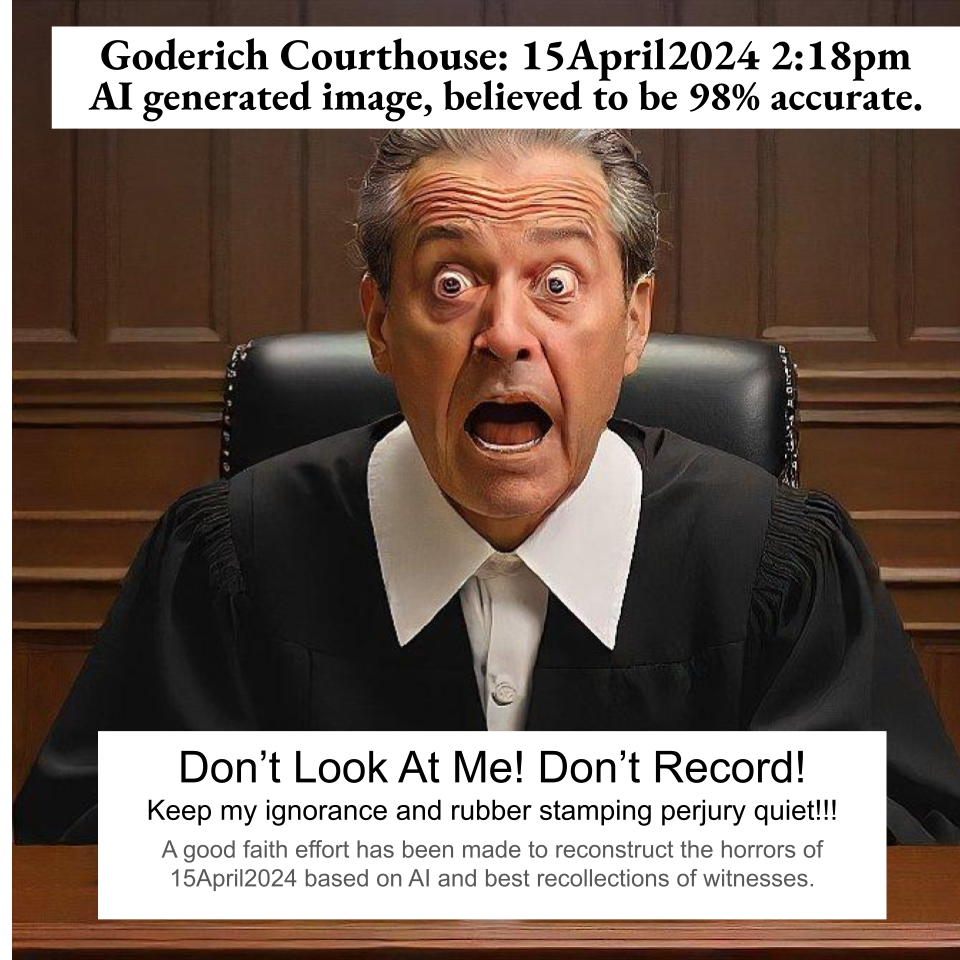
(Goderich, Ontario) The look of terror in the judge’s eyes as he sheepishly slinked into the courtroom was apparent. Several morbidly obese police filled the room. Accompanying them was a stench of sour milk and body odor, likely due to the inability of the portly officers to maintain a satisfactory level of personal hygiene due to their obesity.
Monday 15April 2:00 the courthouse was virtually shutdown for the appeal continuation of a Wingham restaurant owner. Justice MacDonald claimed he is allowed to override the Canadian Bill Of Rights by claiming his court’s policy overrides all rights and protections offer by the Supreme Law Of the Land. Reporters are not allowed to record for accuracy, and victims can’t video record for their own protection in his presence.
At the start of the appeal the terrified and confused judge had to be reminded by the gracious court staff on how he said they were going to proceed. Once the stench of the judge’s brain fart dissipated, he remembered what he said, calmed down, tantrum was over and the Activist was allowed to proceed.
Due to Timothy Gordon MacDonald’s ($356,021/year) threatening to destroy anyone that digitally records and reports on his actions/inactions, there is no option other than having Artificial Intelligence fill in the gaps and create the images based on the best recollections of witnesses.
MacDonald will be releasing his ruling on 11July2024. Numerous writeups detailing the Activists appeal will be release between now and then.
(Goderich, Ontario) The look of terror in the judge’s eyes as he sheepishly slinked into the courtroom was apparent. Several morbidly obese police filled the room. Accompanying them was a stench of sour milk and body odor, likely due to the inability of the portly officers to maintain a satisfactory level of personal hygiene due to their obesity.
Monday 15April 2:00 the courthouse was virtually shutdown for the appeal continuation of a Wingham restaurant owner. Justice MacDonald claimed he is allowed to override the Canadian Bill Of Rights by claiming his court’s policy overrides all rights and protections offer by the Supreme Law Of the Land. Reporters are not allowed to record for accuracy, and victims can’t video record for their own protection in his presence.
At the start of the appeal the terrified and confused judge had to be reminded by the gracious court staff on how he said they were going to proceed. Once the stench of the judge’s brain fart dissipated, he remembered what he said, calmed down, tantrum was over and the Activist was allowed to proceed.
Due to Timothy Gordon MacDonald’s ($356,021/year) threatening to destroy anyone that digitally records and reports on his actions/inactions, there is no option other than having Artificial Intelligence fill in the gaps and create the images based on the best recollections of witnesses.
MacDonald will be releasing his ruling on 11July2024. Numerous writeups detailing the Activists appeal will be release between now and then.
Toronto, ON – The Alcohol and Gaming Commission of Ontario (AGCO) has issued an Order of Monetary Penalty totaling $200,000 to 2776112 Ontario Inc., the licensed operator of the Cannabis Xpress chain of cannabis retail stores, for alleged violations of Ontario’s regulatory standards related to provincial anti-inducement laws.
The provincial Cannabis Licence Act, 2018 and the AGCO’s Registrar’s Standards for Cannabis Retail Stores (the Standards) prohibit Ontario cannabis retailers from asking for or accepting inducements from cannabis producers as a condition of selling or giving preferential treatment to products in their stores.
After receiving information regarding inducement activity, the AGCO undertook compliance inspections of Cannabis Xpress, including a review of over 82,000 relevant documents, and found that Cannabis Xpress’s so-called “Data Services Program” and/or other agreements, which it entered into with licensed cannabis producers (LPs) are, in fact, an inducement program.
Notably, over a period of at least 30 months, the licensee repeatedly sought the participation of over a dozen LPs in so-called “data service” or other such agreements. These agreements were actually an indirect means of requesting and accepting prohibited inducements where, for a fee or a percentage of product sales, Cannabis Xpress gave preferential treatment to products from LPs that had executed such unlawful agreements to the disadvantage of those that had not.
For example, the licensee refused to stock an LPs product unless they agreed to enter into prohibited inducement agreements and promoted the sale of cannabis products from producers who entered such inducement deals. It was found that the licensee attempted to disguise these illegal payments as agreements for the sale of data for business intelligence purposes, which are permissible under the Standards.
The AGCO is committed to ensuring that the cannabis retail sector operates with honesty, integrity and in the public interest.
A licensed retailer served with an Order of Monetary Penalty by the AGCO has the right to appeal the Registrar’s action to the Licence Appeal Tribunal (LAT), an adjudicative tribunal independent of the AGCO and part of Tribunals Ontario.
(Huron, On) Destroying or tampering with evidence as a government official is a serious offense with significant legal consequences. The specific penalties and repercussions for such actions vary depending on the jurisdiction and the nature of the evidence involved. Below are some potential legal consequences for government officials who destroy or tamper with evidence:
1. Criminal Charges: Government officials who deliberately destroy or tamper with evidence may face criminal charges, such as obstruction of justice, tampering with evidence, or even destruction of evidence. These offenses can carry severe penalties, including fines, imprisonment, and damage to their professional reputation.
2. Civil Liability: In addition to criminal charges, government officials may also face civil lawsuits for their actions. Individuals or entities affected by the destruction or tampering of evidence could seek damages for any harm caused, such as loss of rights, financial losses, or reputational harm.
3. Dismissal or Suspension: Government officials found guilty of destroying or tampering with evidence may face disciplinary actions within their organization. Depending on the severity of the offense, they could be dismissed from their position, suspended, demoted, or face other administrative sanctions.
4. Legal Consequences for the Case: Destroying or tampering with evidence can significantly impact the outcome of a legal case. In criminal proceedings, the prosecution may be unable to prove its case without crucial evidence, leading to the dismissal of charges or acquittal of the defendant. In civil cases, the destruction of evidence could result in adverse judgments against the government entity and its officials.
The acceleration of society’s downfall due to government officials destroying or tampering with evidence can have several far-reaching consequences:
1. Erosion of Trust in Institutions: When government officials engage in actions that undermine the integrity of the justice system, it erodes public trust in the government and institutions. Citizens may lose faith in the fairness and impartiality of the legal system, leading to decreased confidence in the rule of law.
2. Injustice and Impunity: Destroying or tampering with evidence can lead to miscarriages of justice, where innocent individuals are wrongly convicted or guilty parties escape accountability. This perpetuates a culture of impunity and injustice within society, breeding resentment and disillusionment among the populace.
3. Deterioration of Rule of Law: The rule of law is a cornerstone of a democratic society, ensuring that all individuals, including government officials, are subject to the law and accountable for their actions. When officials engage in criminal behavior such as destroying evidence, it undermines the rule of law and erodes the principles of justice and equality before the law.
4. Social Unrest and Distrust: The discovery of government officials engaging in misconduct, such as destroying evidence, can provoke social unrest, protests, and civil disobedience. Distrust in government institutions can lead to destabilization, polarization, and conflict within society, further accelerating its downfall.
In conclusion, the destruction or tampering with evidence by government officials is a serious breach of ethical and legal standards that can have profound consequences for individuals, institutions, and society as a whole. Upholding the rule of law, ensuring accountability, and maintaining transparency are essential to prevent the acceleration of society’s downfall due to such misconduct.
(Goderich, On) When a judge ignores and refuses to address perjury committed by government officials or police in their courtroom, it has severe consequences for justice, freedom, and equality.
First and foremost, allowing perjury to go unchecked undermines the credibility of the judicial system. Perjury is a serious offense that is punishable by law, and when it is committed by those in positions of power, such as government officials or police officers, it erodes the public’s trust in the legal system. By turning a blind eye to perjury, judges are essentially condoning dishonesty and corruption within the justice system, which can have devastating effects on the fairness and integrity of court proceedings.
Furthermore, ignoring perjury by government officials or police perpetuates a culture of impunity and privilege. When those in positions of authority are allowed to lie under oath without facing any consequences, it sends a message that they are above the law and can act with impunity. This not only undermines the rule of law but also contributes to a system where certain individuals are given preferential treatment based on their status or position, rather than being held accountable for their actions.
The refusal of a judge to address perjury by government officials or police also has a chilling effect on the pursuit of justice. Victims of perjury may be discouraged from coming forward or speaking out against powerful individuals if they believe that their claims will be dismissed or ignored by the court. This not only denies victims their right to seek justice but also perpetuates a cycle of injustice and inequality within the legal system.
In conclusion, the failure of a judge to address perjury by government officials or police in their courtroom has dire consequences for justice, freedom, and equality. It erodes public trust in the legal system, perpetuates a culture of impunity and privilege, and discourages victims from seeking justice. It is essential for judges to uphold the principles of honesty, accountability, and fairness in order to ensure that justice is served and equal rights are upheld for all individuals.