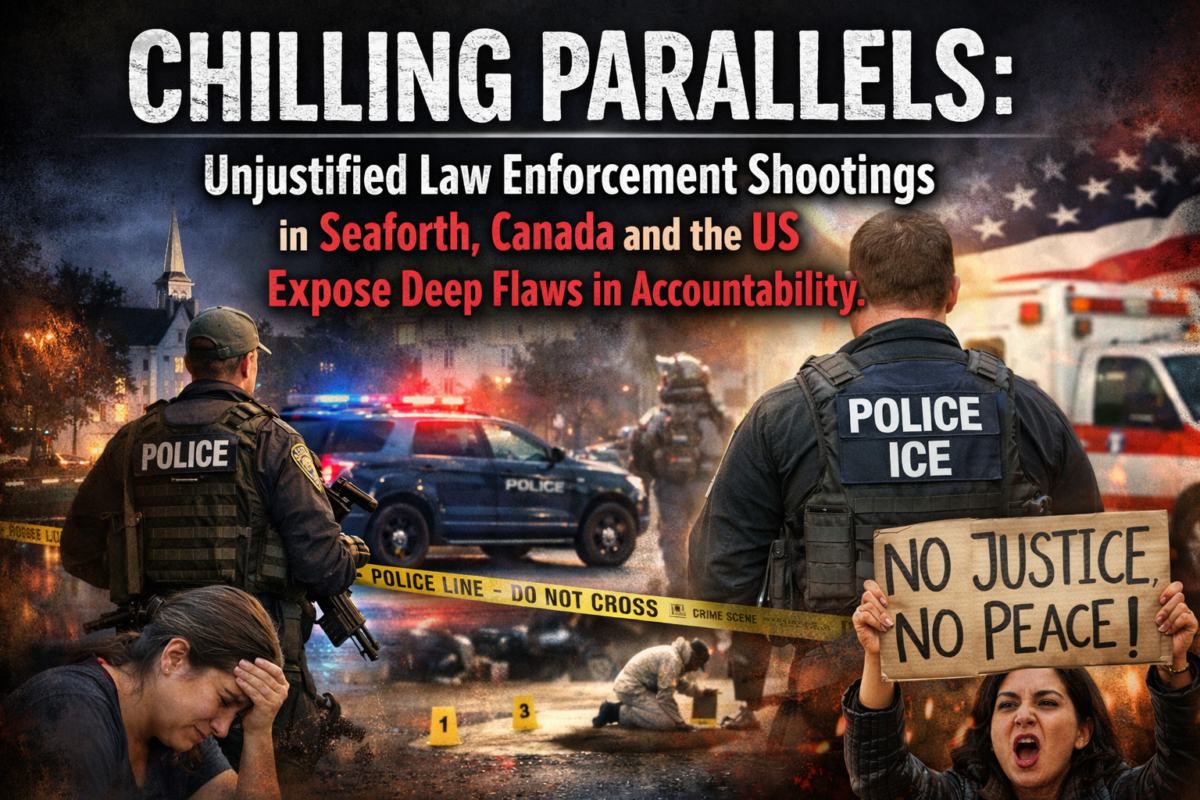
In an era where body cameras, bystander videos, and public scrutiny are meant to hold law enforcement accountable, two recent shootings—one in the United States and one in Canada—reveal a disturbing pattern of excessive force and systemic protection for officers. The fatal shooting of Renee Nicole Good, a 37-year-old American mother, by a U.S. Immigration and Customs Enforcement (ICE) agent in Minneapolis echoes the controversial wounding of two unarmed civilians by an Ontario Provincial Police (OPP) officer in Seaforth, Ontario. Both incidents involve officers firing into moving vehicles under questionable circumstances, raising alarms about unjustified violence and the near-impenetrable barriers to justice. For Canadians, this comparison serves as a stark reminder: our systems may be as flawed—or even more insulated from reform—than those south of the border.
The U.S. Incident: A Mother’s Life Cut Short Amid Immigration Enforcement
On a snowy January morning in 2026, Renee Nicole Good, a 37-year-old U.S. citizen, award-winning poet, and mother of three, was killed in her Honda SUV in south Minneapolis. Good and her wife, Becca, had arrived at the scene of an ICE operation to support neighbors targeted in an immigration raid, equipped only with whistles as a form of peaceful protest. According to federal accounts, Good attempted to run over ICE agent Jonathan Ross, a veteran officer, prompting him to fire in self-defense. However, video footage captured by Ross himself tells a more nuanced—and contested—story.
The 47-second clip shows Ross approaching Good’s vehicle, where she is seated with her dog in the back. Good calmly responds to the agent, saying, “That’s fine dude. I’m not mad at you,” while her wife challenges him from afar. As Good reverses slightly and turns the wheel to pull forward, Ross positions himself in front of the SUV. The camera jerks, bangs ring out, and Good’s vehicle veers away before crashing. Critics, including Minneapolis Mayor Jacob Frey, have called the federal narrative “garbage,” arguing the video shows no clear intent to harm and that Good posed no imminent danger. Bystander videos further depict ICE agents blocking a doctor from aiding Good as she lay dying.
The shooting has ignited nationwide protests, with demonstrators decrying it as an example of ICE’s aggressive tactics, including firing into moving vehicles—a practice many U.S. police departments explicitly warn against due to its risks and ineffectiveness. ICE policy, however, lacks such clear prohibitions, allowing officers broader discretion. This incident fits a broader pattern of alleged ICE abuses, from smashing car windows to using tear gas on witnesses.
The Canadian Counterpart: A Local Shooting Shrouded in Controversy
Just over two years earlier, on October 18, 2023, a similar scene unfolded in the quiet town of Seaforth, Ontario, in Huron County. OPP officers were pursuing a reported stolen vehicle when they located a white SUV occupied by two unarmed civilians—a 35-year-old man (Complainant #1) and a 34-year-old woman (Complainant #2). As officers approached on foot, ordering the occupants to exit, the driver (Complainant #2) allegedly drove forward, striking the subject officer (SO). The SO fired three shots into the vehicle: two in quick succession and a third after a pause. Bullets struck the windshield and passenger door, wounding Complainant #1 in the chest and Complainant #2 in the thoracic area.
The official Special Investigations Unit (SIU) report deemed the shooting justified under self-defense provisions of the Criminal Code, citing evidence like tire marks, cartridge casings, and video footage showing the SUV advancing toward the officer. No charges were filed, and the file was closed. However, independent analysis and advocacy groups, such as those highlighted on FilmThePolice.ca, paint a different picture. They allege the shots were fired after the vehicle had passed or was turning away, suggesting retaliation rather than immediate defense. Forensic evidence, including bullet trajectories targeting the passenger side, and audio recordings of delayed gunfire, contradict the self-defense claim, critics argue. Media coverage is accused of using cropped images to obscure bullet holes, fueling claims of a cover-up.
Striking Similarities: Vehicles as Targets, Lives as Collateral
The parallels between these cases are unnerving. Both involve law enforcement officers firing into occupied vehicles during routine or enforcement actions, with claims of vehicular threats used to justify lethal force. In Minneapolis, Good was accused of trying to “run over” the agent; in Seaforth, the SUV allegedly struck the officer. Yet, in both, video and forensic evidence has sparked debates over whether the threat was imminent or exaggerated. Victims in each incident were unarmed civilians—Good a peaceful protester, the Seaforth pair suspects in a non-violent theft—with no weapons found.
More chilling is the shared theme of firing at moving vehicles, a tactic criticized for its danger to innocents and low efficacy in stopping threats. In the U.S., many local police policies prohibit it, yet federal agencies like ICE do not. In Canada, no such explicit ban exists, allowing similar discretion that critics say encourages recklessness.
No Accountability: A Borderless Problem, But Canada’s May Be Worse
The most damning similarity lies in the aftermath: a glaring lack of accountability. In the U.S., the Good shooting has prompted FBI and state investigations, amid public outrage and protests demanding charges. However, legal hurdles abound. Qualified immunity shields officers from civil suits unless rights violations are “clearly established,” and Supreme Court rulings have gutted Bivens claims against federal agents, making monetary damages nearly impossible. The Trump administration’s staunch defense—labeling the incident self-defense and blocking state access—further entrenches impunity. While Good’s family may pursue a Federal Tort Claims Act lawsuit, success is uncertain, and criminal prosecution remains a long shot.
In Canada, the Seaforth case exemplifies even swifter closure. The SIU, Ontario’s police watchdog, exonerated the officer within months, dismissing conflicting evidence and closing the file without charges. Critics decry the SIU’s deference to police narratives, arguing it rewards “reckless violence” and ignores patterns of punitive force. Unlike the U.S., where federal involvement has at least sparked national debate, Canada’s provincial system often resolves such cases quietly, with little federal oversight or public pressure leading to reform.
These protections aren’t anomalies; they’re baked into both nations’ frameworks, allowing officers to act with virtual impunity. In the U.S., political divisions amplify scrutiny, potentially forcing change. In Canada, the quieter process may shield abuses more effectively, fostering a false sense of superiority.
A Wake-Up Call for Canada
As protests rage in the U.S. over Good’s death, Canadians must confront their own backyard. The Seaforth shooting, like Minneapolis, underscores how quickly “self-defense” can justify tragedy, with victims left wounded or dead and families without recourse. If we pride ourselves on being better than our southern neighbors, these cases demand introspection: Are our accountability mechanisms truly superior, or simply less visible? Demanding independent reviews, policy reforms on vehicle shootings, and stronger civilian oversight isn’t just about justice—it’s about preventing the next preventable loss. Until then, the chilling truth remains: north or south, unchecked power claims lives with alarming similarity.